Date: 2008-2010
Medium: Oil on canvas, made in a Chinese painting factory.
Dimensions: Two x 12" (h) x 18"(w) (and increasing in size every time the work is remade).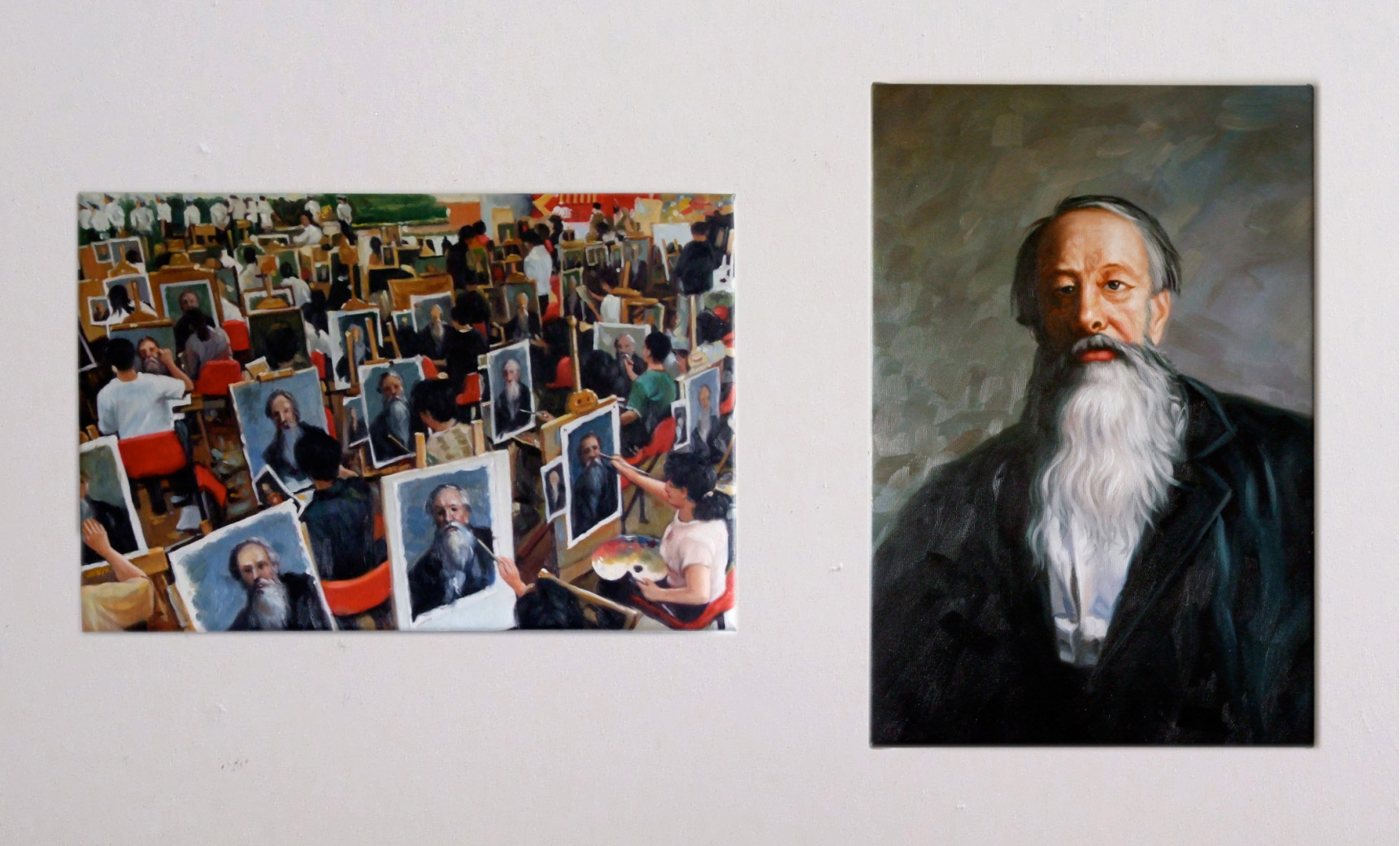
Text from exhibition:
Two 18” x 12” oil paintings hang on a wall. One of them shows lots of artists painting a picture of a man with a beard. The other painting is a portrait of the same old man with a grey beard. On the initial view the only connection between these two oil paintings is the man with the beard. The first image of the artists at work has been appropriated from a photograph I came across this on an Irish blog1 a couple of years ago. The blogger, Conor McGarrigle, had found it on a blog called eyebeam.org, which sourced the image at The Spiegel Online2, which in turn had received the information from the Associated Press.
The original photograph was taken at an oil painting factory in the town of Dafen, China. The Spiegel Online reported that Dafen’s 10,000 painters create 60% of the world mass-produced oil paintings. Dafen is host to many factories full of recent art graduates painting reproductions of iconic oil paintings for a living. 20% of these are sold at Walmart and 20% in the boutiques of Venice. This particular image of a staged-for-the-press-event in which 110 factory workers painted the aforementioned portrait in a timed race
I contacted an Oil Painting factory in Dafen. Emailing the factory a Jpeg of the AP image, I asked them to recreate it as an oil painting. Initially the factory got the order botched and, assuming no one could possibly want a painting of such a boring subject, had produced a portrait of the bearded man. A week after re-ordering the painting, I received the canvas with the image of an oil painting factory in Dafen, China, painted at an oil painting factory in Dafen, China. After this, I contacted the factory again and asked them to re-reproduce for me the painting of the man with a beard. I emailed them back the jpeg image of the bearded man that they had first sent in error, to use as a reference. One week later, I received in the post an oil on canvas painting of a man with a beard copied from a jpeg image of a painting of a man with a beard which was copied from an AP image of many artists painting many pictures of a man with a beard.
Initially, this oil on canvas painting was conceived as a portrait of the production process undertook to create the artwork -a reverberating transmission of the image. The process of making this work demonstrated the potential of reproduction and remix regarding an image or idea. I was also thinking about the possibility of it capturing a snapshot of the process of viewing. However, further events unravelled as I was creating these two images stemming from the difficulty of discovering the identity of the bearded man.
After some aimless internet searches, a curator suggested to me that it could be Leo Tolstoy. Unfortunately this was not to be the case, but the suggestion led me to stumble upon a series of paintings by Ilya Repin, one of Russia’s leading artists of the 19th Century, who painted Tolstoy and my culprit. What made the AP photograph all the more interesting is that the bearded man seems to be Vladimir Stasov a godfather-like figure to the Russian art movements of the 19th century. He was an art critic who wanted Russian art to liberate itself of what he saw as Europe’s hold. By copying the west, he felt, Russian art could only ever be second-rate. However, by borrowing from their own native traditions, they might create a truly national art that could match Europe’s with its high artistic standards and originality” 3. This discovery created a whole new level of meaning for the original AP photograph. If the use of Stasov as a subject for the painting competition was an intentional decision made by some unknown person, the obvious connection between his beliefs and what the activities at Dafen is fascinatingly humorous and critical. If the Stasov portrait was a critique of the situation in Dafen, its meaning would possibly never have been realised or commented upon until this bizarre research. Aesthetically, my portrait of Rebin’s Stasov has deviated dramatically from the original. It no longer serves its original purpose: to capture and glorify an individual. My Stasov does not necessarily serve the purpose of critiquing Dafen either. Instead it implies a history of mutations of meaning within one image. The aesthetic deviation becomes merely a bi-product of the images’ lifespan and journey over which neither the image nor it’s creators have control. The result is just two static 18” x 12” oil paintings, which are neither starting points nor end points riding a wave of a reverberating feedback loop that is the same as that place where we all work every day – “The Image Factory”.
1 http://www.stunned.org/weblog/2007/01/chinas_art_factories.html
2 http://www.spiegel.de/international/0,1518,433134,00.html
3 http://en.wikipedia.org/wiki/Vladimir_Stasov